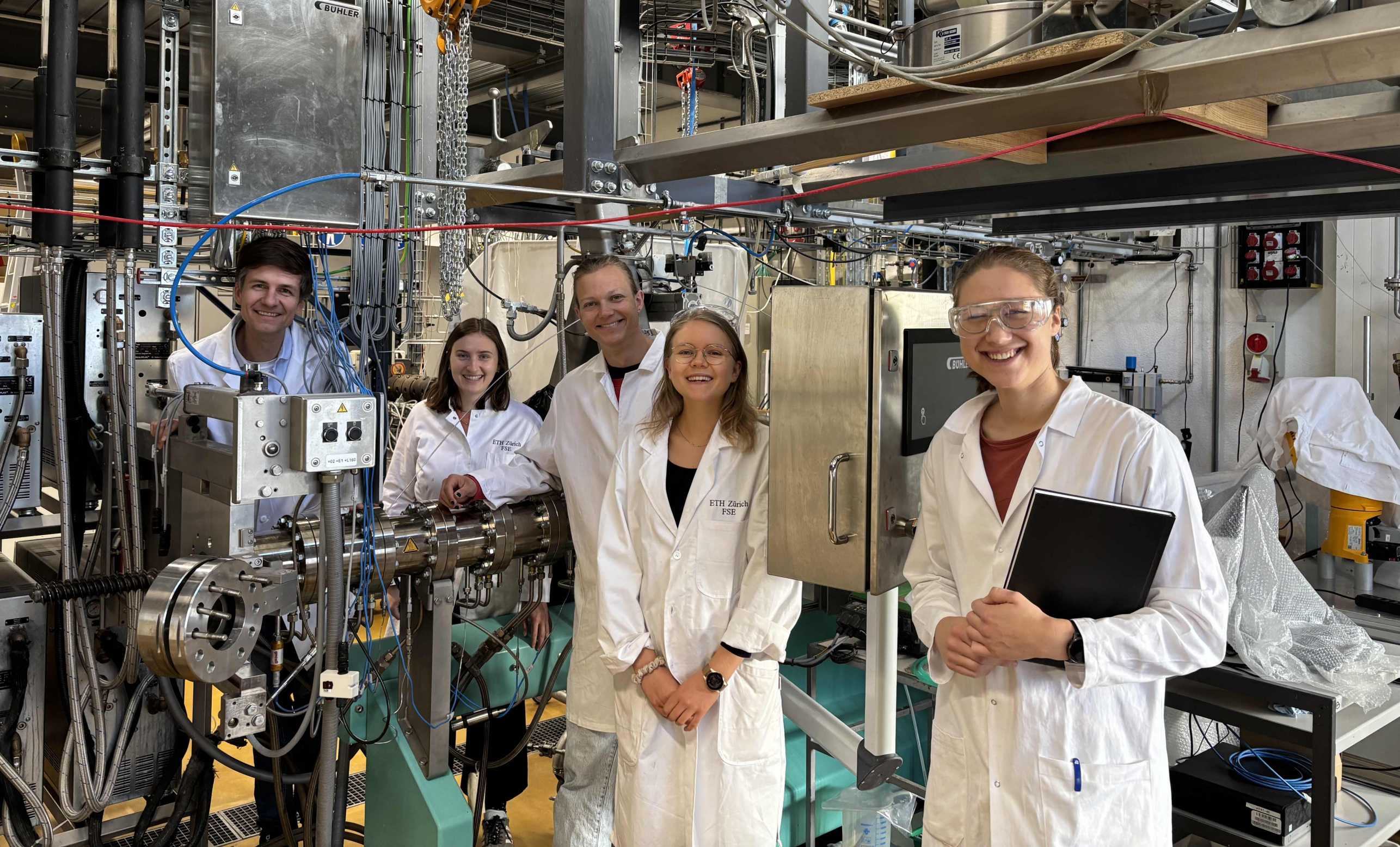
BSc and MSc Students
We are looking for motivated students for BSc and MSc thesis projects who are eager to conduct hands-on research.
Option 1: Check out our open projects on SiROP
From Microscopy Images to Reproducible Cell Analysis
Microscopy images are often used to study spores, yeasts, microalgae, and other small biological systems in food biotechnology. Counting cells and assigning growth states, however, still requires repetitive manual work and can vary between analysts. This makes experiments slower to screen and harder to compare. This thesis will help develop a local, free-to-use image-analysis tool for non-programmers. The existing software includes an automated processing pipeline, conservative machine-learning predictions, visual overlays, and a user-friendly interface. The student will refine and test this workflow for food-related applications such as fungal spore counting, microalgae monitoring, yeast analysis, and growth-state classification. The goal is to reduce manual microscopy work while keeping the results easy to inspect and correct. Analyst corrections will be saved in a structured format, allowing the tool to improve over time and supporting more reproducible image-based measurements in food biotechnology.
Keywords
Food Biotechnology, Microscopy, Image Analysis, Computer Vision, Machine Learning, Cell Counting, Fungal Spores, Microalgae, Yeast, Fermentation, Python, GUI, Data Analysis, Reproducibility
Labels
Master Thesis , ETH Zurich (ETHZ)
Description
Goal
Contact Details
More information
Open this project... call_made
Published since: 2026-06-15 , Earliest start: 2026-08-01 , Latest end: 2026-10-30
Organization Laboratory of Food Structure Engineering
Hosts Pampoukis Georgios
Topics Agricultural, Veterinary and Environmental Sciences , Medical and Health Sciences , Information, Computing and Communication Sciences , Engineering and Technology , Chemistry , Biology
From Scientific Papers to AI tools for Food Business Operators
Food research contains large amounts of information on processing, fermentation, structure, safety, and quality, but much of it remains difficult to reuse because it is stored in scientific papers. This thesis will contribute to a local and user-friendly workbench that extracts information from PDFs and converts it into structured food science datasets. The tool already includes a Python/FastAPI framework for extracting text, tables, figures, and provenance, with optional support from local large language models. The student will test and refine the workflow using food-related case studies such as solid-state fermentation, extrusion, thermal processing, or non-thermal processing.
Keywords
Food Science, Food Technology, Artificial Intelligence, Machine Learning, Large Language Models, Literature Review, Data Extraction, Scientific Papers, Food Processing, Fermentation, Process Optimization, Decision Support, Python, Web App
Labels
Master Thesis , ETH Zurich (ETHZ)
Description
Goal
Contact Details
More information
Open this project... call_made
Published since: 2026-06-15 , Earliest start: 2026-09-01 , Latest end: 2026-11-30
Organization Laboratory of Food Structure Engineering
Hosts Pampoukis Georgios
Topics Agricultural, Veterinary and Environmental Sciences , Medical and Health Sciences , Information, Computing and Communication Sciences , Engineering and Technology , Biology
Cold-set gelation of lupin protein: Influence of fiber addition and processing across different system complexities
Lupins are a promising raw material with an exceptional composition, containing 31–52% protein as well as dietary fibers, valuable fatty acids, vitamins, and minerals. Together with their low soil requirements, these properties highlight the potential of lupins as a sustainable alternative protein source. Gelation is a key technofunctional property in food systems, as it governs the formation and stability of structured matrices and is therefore crucial for creating products with appealing texture. Conventionally, protein gelation is achieved via heat-induced denaturation and subsequent network formation during cooling. However, lupin proteins exhibit relatively high thermal stability and do not readily form stable gels using this approach. Therefore, alternative gelation mechanisms need to be explored. One promising strategy is cold-set gelation, which relies on acid- or ion-induced interactions of pre-denatured proteins. However, cold-set gelation in lupin systems remains underexplored and requires systematic investigation to better understand and optimize this process. This thesis aims to address this gap by systematically investigating cold-set gelation in lupin systems of increasing complexity (protein isolate, flour, seeds) in order to enable the development of stable, structured food products based on lupins.
Keywords
Food Structure Engineering, Food Science, Alternative Proteins, Lupin Proteins, Cold-set Gelation
Labels
Master Thesis , ETH Zurich (ETHZ)
Description
Goal
Contact Details
More information
Open this project... call_made
Published since: 2026-06-04 , Earliest start: 2026-07-01 , Latest end: 2026-09-30
Applications limited to Department of Materials , ETH Zurich , Institute of Food, Nutrition and Health
Organization Laboratory of Food Structure Engineering
Hosts Rentsch Nils
Topics Engineering and Technology
Electrical Monitoring of Fungal Growth in Fermentation
Sustainable food production is essential to meet the demands of a growing global population. Filamentous fungi offer a promising solution by converting plant-based substrates into nutritious, protein-rich food with a significantly lower environmental footprint than livestock. However, one of the main challenges in solid-state fermentation is the lack of reliable methods to monitor fungal growth in real time, as most existing techniques are slow, invasive, and not suitable for continuous observation. This project explores a non-destructive electrical sensing approach to better understand fungal growth and development. Since living fungal cells interact with electric fields, changes in growth and morphology can be reflected in measurable electrical properties such as impedance and capacitance. The goal is to investigate how these electrical signals relate to fungal growth, identify different growth phases, and gain insight into how growth behavior can be tracked over time. Ultimately, this understanding can help improve fermentation processes and contribute to the development of healthy and sustainable food products.
Keywords
Fungal growth, fermentation, solid-state fermentation, sustainable food, food biotechnology, electrical sensing, bio-impedance
Labels
Master Thesis , ETH Zurich (ETHZ)
Description
Goal
Contact Details
More information
Open this project... call_made
Published since: 2026-04-28 , Earliest start: 2026-07-01 , Latest end: 2027-05-31
Applications limited to ETH Zurich , Institute of Food, Nutrition and Health , Institute of Microbiology , Department of Biosystems Science and Engineering , Institute for Electronics
Organization Laboratory of Food Structure Engineering
Hosts Germerdonk Till
Topics Engineering and Technology , Biology
Filamentous Fungal Growth in Hydrophobic and Emulsified Substrates
Fermentation with filamentous fungi is emerging as a key technology for producing sustainable, protein-rich foods from plant-based resources. Aspergillus oryzae, widely used in traditional fermentations such as soy sauce and miso, offers strong enzymatic capabilities that enable the transformation of raw substrates into nutritious and structured products. Many modern food formulations, including plant-based meat alternatives, contain oils or emulsified fats that strongly influence texture and flavour, but also create complex environments for fungal growth that are not yet well understood. This project explores how A. oryzae grows in substrates containing hydrophobic components and how fungal hyphae interact with oil–water interfaces. Using confocal microscopy, fluorescent staining, and material characterization techniques, fungal development will be visualized within heterogeneous structures and related to changes in material properties. The work aims to generate fundamental insights into fungal growth behaviour in multiphase food systems, supporting the development of improved fermentation processes for future sustainable foods.
Keywords
Fermentation, fungi, confocal microscopy, material science, food science, biology
Labels
Master Thesis , ETH Zurich (ETHZ)
Description
Goal
Contact Details
More information
Open this project... call_made
Published since: 2026-04-08 , Earliest start: 2026-04-12 , Latest end: 2027-02-28
Applications limited to Department of Biology , Institute of Food, Nutrition and Health , Department of Materials , Institute of Materials , Center for the Study of Living Systems
Organization Laboratory of Food Structure Engineering
Hosts Germerdonk Till
Topics Engineering and Technology , Biology
Option 2: Didn't find a suitable research project on SiROP?
You're welcome to reach out directly to our PhD students or PostDocs via email. When you do, please include relevant details such as:
- Your research interests (browse current projects here)
- Fields of study
- Preferred timeline (for BSc theses: include if part-time or full time)
- Academic or practical experience
- Any other information that might help us understand your background and goals
We look forward to hearing from you!
Contact
Lebensmittelstrukturverfahrenstech
Schmelzbergstrasse 7
8092
Zürich
Switzerland
Contact
Lebensmittelstrukturverfahrenstech
Schmelzbergstrasse 7
8092
Zürich
Switzerland
Contact
Lebensmittelstrukturverfahrenstech
Schmelzbergstrasse 7
8092
Zürich
Switzerland
Lebensmittelstrukturverfahrenstech
Schmelzbergstrasse 7
8092
Zürich
Switzerland
Contact
Lebensmittelstrukturverfahrenstech
Schmelzbergstrasse 7
8092
Zürich
Switzerland
Lebensmittelstrukturverfahrenstech
Schmelzbergstrasse 7
8092
Zürich
Switzerland
Contact
Lebensmittelstrukturverfahrenstech
Schmelzbergstrasse 7
8092
Zürich
Switzerland
Contact
Lebensmittelstrukturverfahrenstech
Schmelzbergstrasse 7
8092
Zürich
Switzerland
Contact
Lebensmittelstrukturverfahrenstech
Schmelzbergstrasse 7
8092
Zürich
Switzerland
Contact
Dep. Gesundheitswiss. und Technol.
Schmelzbergstrasse 7
8092
Zürich
Switzerland